Unauthorised parking is a real problem
Your parking spaces are regularly occupied, but not by your customers, guests or staff. This is the main reason for parking enforcement.
Are you considering having your car park monitored? Here you will find a checklist for comparing providers, a comparison of towing and cameras, and the key criteria for assessing whether your site is suitable.
Before you sign a contract, it pays to take a close look. These questions will help you compare offers. For each question, we explain why it matters, how to recognise a good answer and how IPM answers it.
IPM · Checklist for site owners · 12 questions for your parking service provider
Tick off the questions a provider has answered convincingly. Printed out, the list serves as a guide for your discussions.
IPM GmbH · Kronprinzenstr. 60 · 40217 Düsseldorf · +49 221 98658083 · info@ipm-park.de
Both have their place. For everyday unauthorised parking, cameras are the less intrusive option; towing remains for genuine obstructions.
Anyone who parks without authorisation on private land interferes with the owner's possession. The Federal Court of Justice (BGH) has ruled that whoever holds the land may have an unauthorised vehicle towed and that the costs are, in principle, to be borne by the person who parked without authorisation (judgment of 5 June 2009, V ZR 144/08).
This does not mean that towing is the right choice in every case. Whether towing is appropriate in an individual case, and which costs must be reimbursed, depends on the circumstances, for example on the signage and on whether anyone was obstructed.
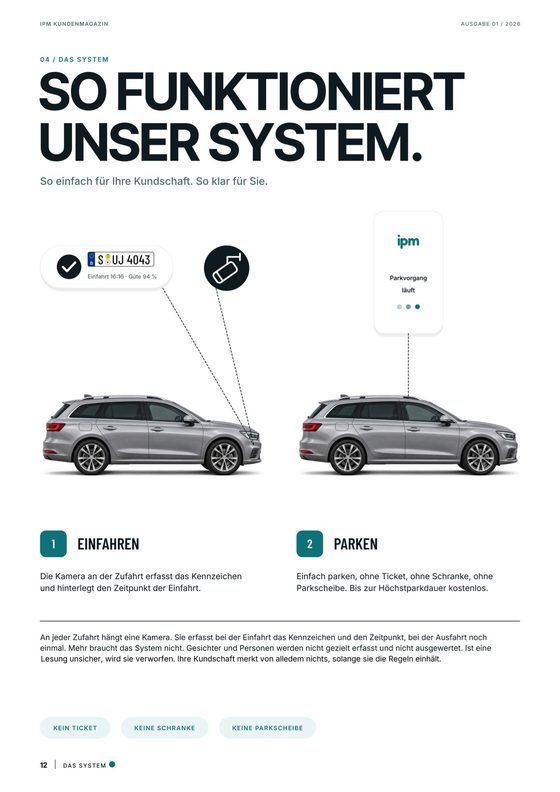
IPM combines both: overstays of the maximum stay are recorded by the cameras, reviewed and notified by post. Vehicles are only towed if they actually obstruct others, and every towing order is reviewed beforehand.
No legal advice. This information is general in nature and is no substitute for advice in an individual case. The decisive factors are the circumstances on site and the legal position applicable at the time.
| Criterion | Towing | Camera-based parking enforcement |
|---|---|---|
| When it applies | In individual cases, when someone on site notices a vehicle and calls a towing service. | Continuously at every entrance and exit, even when nobody is on site. |
| Consequence for drivers | The vehicle is gone and must be collected, which involves effort and expense. | A payment notice by post. The vehicle stays where it is. |
| Effort for you | Staff must notice violations, document them and oversee the towing operation. | No on-site action required. You manage exemptions and reports in the customer portal. |
| Evidence | Photos and handwritten notes, depending on who happens to be on site. | Number plate and time on entry and exit. Every case is reviewed by a person before it is sent. |
| Relationship with customers | A towed vehicle frequently causes annoyance, including among customers who simply needed a little longer. | Unclear reads are discarded; appeals can be submitted online and are reviewed personally. |
| When it makes sense | When a vehicle actually obstructs others, for example by blocking an access road or an emergency route. | When unauthorised parkers regularly occupy parking spaces intended for your customers. |
Further information: Towing at IPM · Legal basis
There is no fixed minimum size. What matters is whether your site has a problem with unauthorised parking and whether the equipment can be installed sensibly.
The following points provide initial guidance. We clarify whether they apply to your site during a site survey of about 15 minutes. The free measurement phase of four to eight weeks then shows, with real data, how your site is used. Afterwards, you receive a site report.
Your parking spaces are regularly occupied, but not by your customers, guests or staff. This is the main reason for parking enforcement.
For example, a customer car park, a visitor car park or parking spaces for a specific group of users. A clear rule can then be set and signposted.
Vehicles reach the site via fixed entrances and exits. As a rule, one camera is used per entrance or exit.
The equipment at the entrances requires a power connection. We clarify where it is located and how the equipment will be supplied during the site survey.
There should be mobile reception at the entrances. We check on site whether it is sufficient.
At every entrance, it must be possible to place a clearly visible sign so that drivers know the rule before they park.
For owners, managers and operators of private car parks, for example at stores, hospitals, hotels or residential complexes, who are considering parking enforcement.
Yes. The questions are worded in general terms. IPM's answers are shown alongside each one so that you can compare.
Nothing. The site survey takes about 15 minutes, and the subsequent measurement phase of four to eight weeks is free of charge. Afterwards, you receive a site report.
No. It explains general principles. For the assessment of an individual case, please consult a lawyer.
During the free site survey, we answer your questions on your site. In the measurement phase, you can see how it is used.
IPM in words and figures: what happens on your site, what you get from it and how to get there. For reading on screen or passing on. The magazine is in German.